
MU Veterinary Medical Diagnostic Laboratory

  • Home
  • About
    • Mission Statement
    • AAVLD Accredited Lab
    • NAHLN Level 1 Lab
    • FDA Vet-LIRN Tier I Lab
    • NPIP Lab
    • Our Location
    • Quality Assurance System
      • Login to VMDL QA/QC Site
    • Policies
      • Basic VMDL Policies
      • Use of VMDL Necropsy Facility
  • Tests and Fees
    • Browse by Category
    • Avian Tests and Fees
    • Canine Tests and Fees
    • Equine Tests and Fees
    • Feline Tests and Fees
    • One Health-Rabies Laboratory
    • Porcine Tests and Fees
    • Ruminant Tests and Fees
    • Fee Guide (PDF)
  • Submission Forms
  • Lab Sections
    • Director’s Office
    • Anatomic Pathology
    • Avian Pathology
    • Bacteriology & Mycology
    • Clinical Pathology
    • Histopathology
    • Molecular Diagnostics
    • One Health-Rabies Laboratory
    • Serology
    • Analytical Chemistry and Toxicology
  • Accounting and Billing
  • Resources
  • FAQs

Under the ‘Scope – Fall 2025


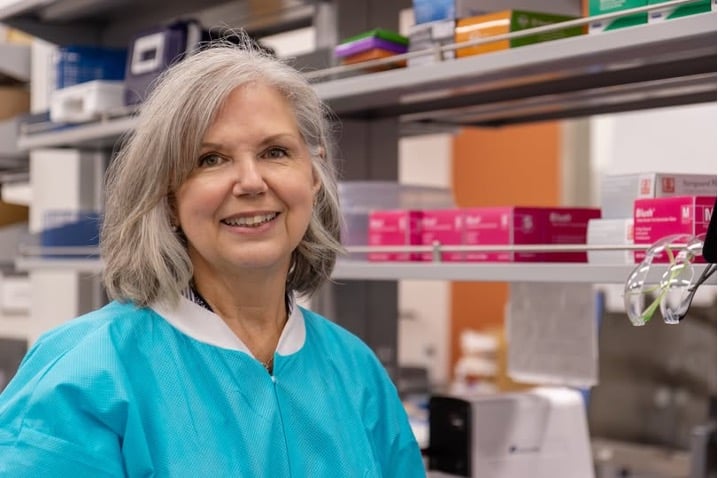
Dr. Susan Moore Speaks at the Rabies in the Americas Conference

Dr. Susan Moore represented the CVM October 19th- 24th at the Rabies in the Americas conference in Lima, Peru. Her talk focused on finding practical, alternative ways to gather rabies testing data in under-resourced, high-risk areas — work that supports stronger vaccination programs and saves lives around the world.


VMDL Pathologists and Residents Showcase Strong Anatomic Pathology Program at Annual ACVP Meeting

The VMDL anatomic pathology team made a strong impression at this year’s meeting, and we are proud to share their outstanding contributions—a true testament to VMDL’s diagnostic expertise, scholarly activity, and residency training program.

  • Dr. Alexis Carpenter, who became a new Diplomate of ACVP in 2025, presented her diagnostic case (podium, co-authored by Dr. Dae Young Kim), “Uterine Choriocarcinoma in a Dog,” featuring an excellent immunohistochemical investigation characterizing this rare lesion. Dr. Carpenter also received the Davis-Thompson Foundation Pathology Trainee and Scholarship Award.
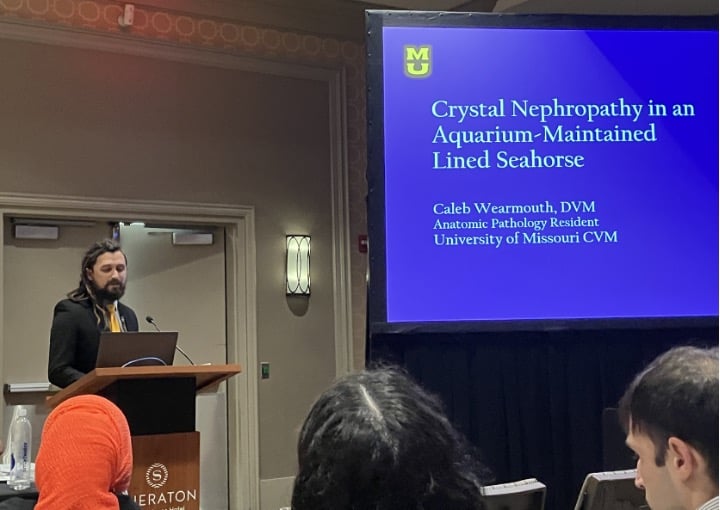
  • Dr. Caleb Wearmouth presented his diagnostic case (podium, co-authored by Dr. Dae Young Kim), “Crystal Nephropathy in an Aquarium-Maintained Lined Seahorse,” which sparked engaging discussions on this fascinating case.
  • Dr. Stephanie Anderson presented her diagnostic case (poster, co-authored by Dr. Kei Kuroki), “Mast cell tumor in a pet Cairo spiny mouse,” providing valuable clinicopathologic insights into this uncommon neoplasm in pet rodents.
  • Dr. Kei Kuroki presented a retrospective study of 120 canine stifle biopsies (poster) and co-authored a project on newly identified canine systemic amyloidosis (3rd place award), a collaboration with Dr. Natsumi Kobayashi (Tokyo University of Agriculture and Technology) developed during her externship at VMDL.

Congratulations Anatomic Pathology Team!


MU VMDL Closed for Veterans Day 2025

The University of Missouri is observing Veterans Day 2025 as a public holiday for all employees. Accordingly, the MU VMDL will be closed on Tuesday November 11th, 2025.

Please consider holding perishable samples and understand that holidays are not included in VMDL turnaround time estimates.

Arrangements to drop off animals for necropsy can be made with the on-call student by calling 573-864-7160.


An update on bovine theileriosis

You’ve probably heard about the longhorned tick (Haemaphysalis longicornis). This invasive species transmits Theileria orientalis, a protozoal organism that infects bovine red blood cells and causes a hemolytic anemia similar to bovine anaplasmosis.

Native to eastern Asia, the longhorned tick was first recognized in the U.S. in 2017 and has since been confirmed in 24 states. It was first detected in Greene County, Missouri in June 2021 and has since been reported from a total of 8 counties in our state. It’s very likely that the ticks are in other counties but haven’t been recognized yet.

Invasive populations of longhorned ticks are composed almost entirely of asexually reproducing (parthenogenetic) females, allowing a single viable female to establish a new population. Computer models predict that extensive swaths of the U.S. and Mexico are suitable habitats for the tick. Longhorned ticks feed on a wide variety of domestic and wild animals, including birds, which contributes to their adaptability.

Theileria orientalis has 3 predominant genotypes: Ikeda, Chitose, and Buffeli. The Ikeda genotype is the most virulent, causing severe illness and death in up to 5% of infected cattle. Ikeda was first recognized in the U.S. in 2017, in a Virginia beef herd. The illness was initially suspected to be anaplasmosis, but subsequent investigation by the local vet, state veterinary officials, and the U.S. Department of Agriculture identified T. orientalis Ikeda and also found longhorned ticks on the cattle.

Sporadic cases of theileriosis have been detected in Missouri since June 2023. In 2024, a surveillance study conducted by Dr. Ierardi with colleagues from the VMDL, Veterinary Teaching Hospital, and MU Extension documented T. orientalis Chitose and Ikeda genotypes in 7.5% of 147 cattle tested from three cow-calf operations in central and north-central Missouri.

No treatment is currently available, but many infected cattle will recover and remain productive. Cases are reported to the Missouri Department of Agriculture to monitor disease trends, but theileriosis is not federally reportable and does not trigger any official action such as quarantine.

The VMDL offers a fully validated T. orientalis PCR, which detects all of the clinically relevant genotypes. This can be requested as a stand-alone test (Theileria orientalis qPCR, $44) or in combination with Anaplasma marginale PCR (Bovine Tick Panel, $59). Optimal sample types are EDTA-anticoagulated whole blood or fresh spleen.

Additionally, our board-certified clinical pathologists are skilled in the recognition of Theileria organisms on blood smears (Blood Parasite Exam, $25; Blood Smear Exam, Comprehensive, $48). It’s important to note that while blood smears are very useful in the workup of individual sick cattle, they are not sensitive as a herd-level screening test.

If you’re not sure which test option and/or sample type best suits your needs, VMDL faculty and staff are happy to assist at 573-882-6811.

Under the ‘Scope – Summer 2025


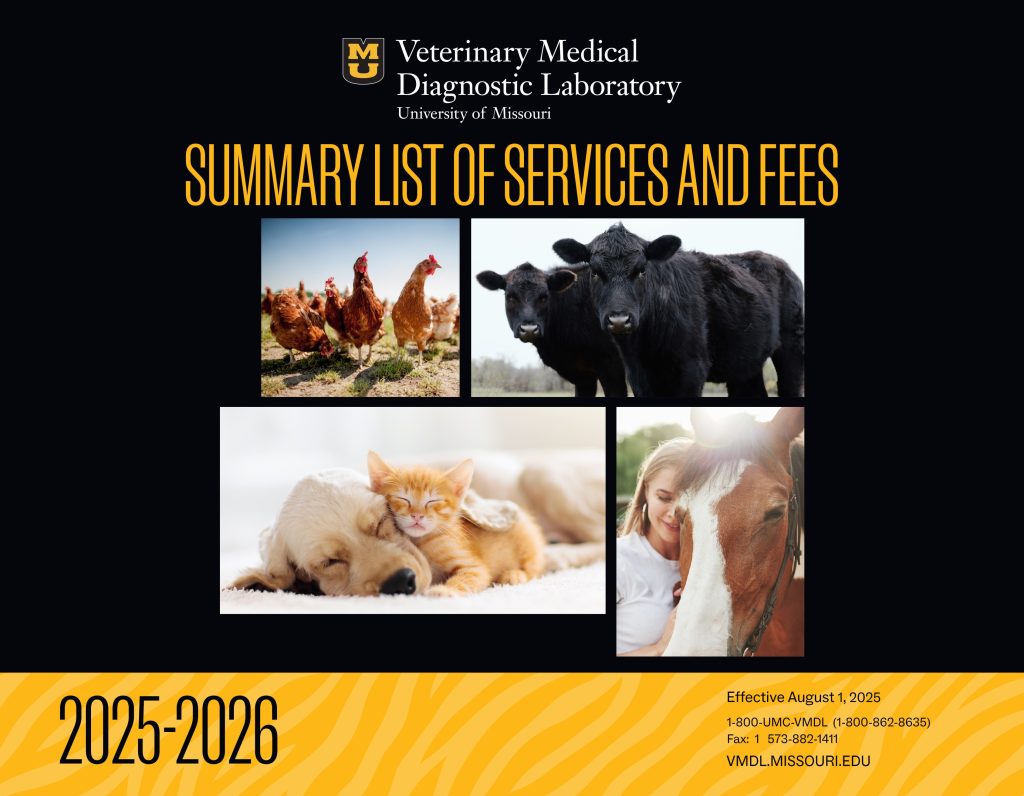
Coming soon: 2025-26 VMDL fee guide

An updated list of our services and fees is coming soon! Keep an eye out and be ready to update your system with our new prices, which are effective Sept. 1, 2025.

New service offerings include:

  • Small animal diarrhea panel for feces or tissues (Anatomic Pathology)
  • Small animal respiratory panel (Anatomic Pathology)
  • Mastitis milk culture (Bacteriology)
  • Small ruminant health panel — CAE/OPP, Johne’s, CL (Serology)
  • Caseous Lymphadentitis (CL) antibody ELISA (Serology)

The following tests have been temporarily discontinued:

  • Electron microscopy (Virology)

Drop-off location update

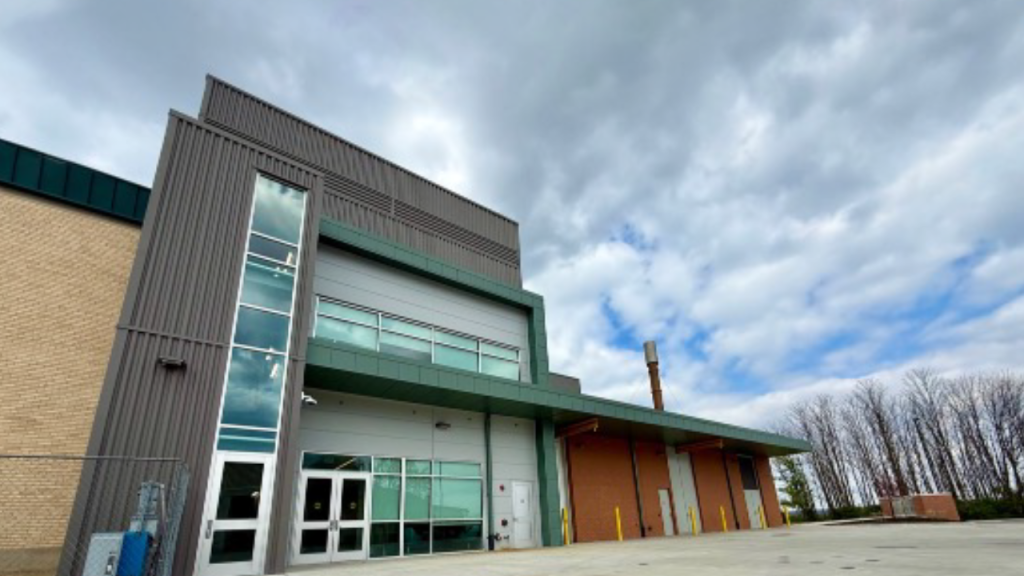
Our Anatomic Pathology and Receiving sections have moved into the new VMDL Phase I facility. To drop off a sample during business hours, please proceed to the south side of the new building and look for the below entrance. A few client parking spaces are available nearby for your convenience.

Never fear, our shipping addresses have not changed.

If you’re using the US Postal Service, ship to:

Mizzou VMDL
P.O. Box 6023
Columbia, MO 65205

If you’re using FedEx*/UPS/DHL, ship to:

Mizzou VMDL
901 East Campus Loop
Columbia, MO 65211

*Please note, our pre-printed billable stamps display a different address. We pick up so you save on shipping.

For after-hours sample drop off, the refrigerator in the Small Animal Lobby of the Veterinary Health Center (Clydesdale Hall) is still available for your use 24/7. After hours drop off of deceased animals for necropsy can be arranged by calling the on-call student at 573-864-7160.


Courtesy USDA

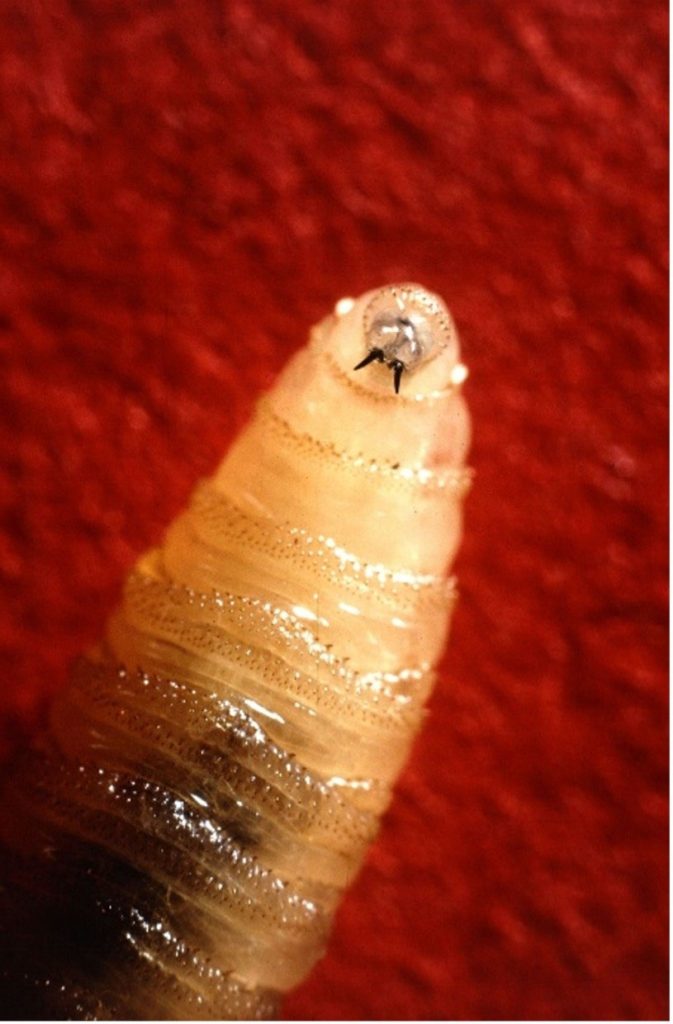
The re-emerging threat of New World Screwworm

For more than 20 years, the biological barrier of the New World Screwworm has been maintained in the Darien Gap region of Panama with sterile fly releases from the COPEG facility. In 2023, the cases of New World Screwworm in Panama increased 250 times over, and the pest began migrating northward. The first case in Mexico was detected in November 2024, and, in early July 2025, a new case was confirmed about 370 miles south of the U.S. border. In May 2025, the U.S. border was closed to Mexican cattle, bison and horses.

The larval stage of the New World Screwworm hatches and feeds on live tissue after the adult female fly lays her eggs near a wound or orifice. All warm-blooded vertebrates including humans and companion animals can be affected, but more than 80% of cases in the current outbreak have occurred in cattle. Cattle with wounds from husbandry procedures such as dehorning, castrating and branding are particularly at risk. Infestation results in devastating deepening wounds and secondary infections and has a near 100% mortality at 14 days if left untreated.

New World Screwworm
Photo courtesy of USDA

Any suspected cases of New World Screwworm myiasis should be reported immediately to your state animal health official and the USDA area veterinarian in charge. Sterile fly release has been diverted to Mexico and sterile fly production is ramping up with new production and dispersal facilities in Metapa, Mexico and Texas. For more information on New World Screwworm and the current situation, please visit the USDA-APHIS website at https://www.aphis.usda.gov/livestock-poultry-disease/cattle/ticks/screwworm.

Annabelle Burnum awarded LEAP Fellowship

Selection as a LEAP Fellow reflects Burnum’s outstanding promise as a scholar, educator and contributor to the university’s mission.

Longhorned Tick Discovered in Northern Missouri for First Time, MU Researchers Find

The Longhorned tick causes the loss of millions of dollars in agricultural revenue to cattle producers worldwide, and it is now in northern Missouri.

Guidance for Submissions During VMDL Construction Project

Due to the location of the Phase 1 VMDL construction project, a section of East Campus Loop to the east of the VMDL will be closed to through traffic. However, to ensure continuity of operations, access to the VMDL will still be available. Please read the following instructions carefully.

The VMDL receiving entrance and loading dock area on the north side of the building will be accessible to our clients throughout the construction process. However, this area must be approached from the north, by way of East Campus Loop. The VMDL receiving and loading dock areas will NOT be accessible from the south, by way of East Campus Loop or Cattle Drive.

If you have any questions or need directions, please call the lab at 573-882-6811. Thank you for your patience and understanding as we update our facilities!

  • 1
  • 2
  • 3
  • …
  • 7
  • Next Page »

Lab Sections

  • Anatomic Pathology
  • Avian Pathology
  • Bacteriology & Mycology
  • Clinical Pathology
  • Histopathology
  • Serology
  • Analytical Chemistry and Toxicology
  • Molecular Diagnostics

Message from the Director

The University of Missouri Veterinary Medical Diagnostic Laboratory (VMDL) is a full-service veterinary diagnostic laboratory and Missouri’s only laboratory accredited by the American Association of Veterinary Laboratory Diagnosticians. The VMDL is a Level I Lab of the National Animal Health Laboratory Network, Tier I Lab of the FDA Veterinary Laboratory Response Network, and a National Poultry Improvement Plan authorized lab. The VMDL maintains an effective quality assurance and quality control program.

The VMDL has formal anatomical pathology, clinical pathology, and clinical microbiology training programs. The VMDL faculty hold academic appointments in the Departments of Veterinary Pathobiology and Veterinary Biomedical Sciences. The director is administratively responsible to the dean of the College of Veterinary Medicine for the overall operation of the laboratory and its multiple missions of public service, teaching, research and continuing education/extension.

The VMDL faculty and staff work diligently to provide relevant, timely and cost-effective diagnostic services to our clients and to create a positive learning environment for our students and residents. In 2024, veterinarians, animal owners and researchers from 103 Missouri counties and cities, as well as from 51 states and provinces outside Missouri, continued to rely on the Veterinary Medical Diagnostic Laboratory’s (VMDL) diagnostic services. The lab performed approximately 63,500 total cases and conducted nearly 204,500 tests.

About the MU VMDL

The VMDL is a full-service laboratory accredited by the American Association of Veterinary Laboratory Diagnosticians (AAVLD). The VMDL provides in-depth laboratory diagnostic support to veterinary practitioners, livestock and poultry industry interests, companion animal interests, wildlife conservationists, scientists utilizing animals in their research throughout the university, state and regulatory officials, and clinicians of the MU Veterinary Health Center.

Our Location

Click to open a larger map

901 E. Campus Loop
Columbia, MO 65211

VMDL News

  • VMDL Newsletter
  • Bovine Diagnostic Summaries

VMDL Annual Reports

  • 2024 Annual Report
  • 2023 Annual Report
  • 2022 Annual Report
  • 2021 Annual Report
  • Annual Report Archive

VMDL Employment

  • Faculty Employment
  • Staff Openings
  • Residencies
  • Pathology Externship

Contact

  • Contact the VMDL
  • CVM Director of Communications
  • CVM Webmaster

Links

    • College of Veterinary Medicine
    • Biomedical Sciences
    • Veterinary Pathobiology
    • Veterinary Medicine and Surgery
    • Veterinary Health Center (VHC)


© 2025 — Curators of the University of Missouri. All rights reserved. DMCA and other copyright information. An equal opportunity/access/affirmative action/pro-disabled and veteran employer. Disability & Accessibility information